§ 01 — THE CONCEPT
Concrete That Floats
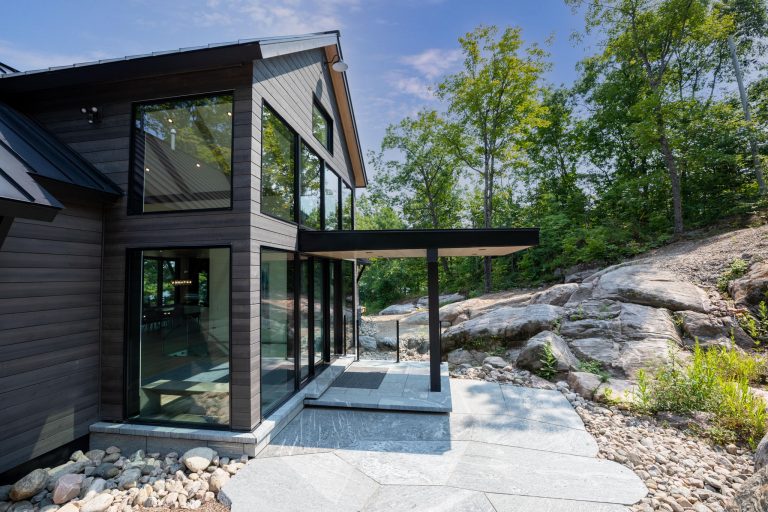
The Little Lake Joseph Cottage is a project where almost every decision trades complexity for a result that doesn’t look possible from the outside. The first thing you see is the wall. We’re pouring an above-grade concrete wall along the perimeter and then cantilevering it out from the structural frame on steel C channels. When it’s done, that wall will appear to float — no visible support, a surface that reads as independent from the structure behind it.
The concrete patio works the same way. It cantilevers out the same depth as the wall above, so from outside the building the whole concrete shell — wall and patio together — appears to hover around the perimeter. The hammered finish brings it back to something material and tactile. It’s a lot of engineering to achieve something that looks effortless.
§ 02 — THE STRUCTURE
Steel, Concrete, and a Web of Engineering
Under the surface complexity, this building has a web of steel that makes it work. We’re working with DKG Engineering out of Port Carling — the same team we bring in for our most structurally demanding projects. The C channels supporting the cantilevered wall are just the start. The second floor has support points set away from the corners, leaving one corner of the covered patio essentially floating without a post. That kind of structural gymnastics requires close coordination between frame, formwork, and steel.
Kenora Bay is handling the steel work. Huntsville Concrete is doing the pours. Scott Custom Building is managing the build. Snowetta is the design architect driving the concept. On a project this complex, the contractor and engineer coordination is as important as the design itself.
§ 03 · THE TOUR
Watch the Full Walkthrough
We filmed this during framing and foundation — the structure is fully visible, the cantilevered concrete geometry reads clearly, and the scale of the building is apparent before the finishes go on.
§ 04 — THE PLAN
Entry, Screen Porch, and a Lake-Facing Kitchen
The entry comes in along the back wall of the cottage. Immediately to the left is a covered porch — screened in with retractable drop-down screens so it can be fully open on a good day and fully closed when the bugs arrive. The second floor sits above this portion of the building, adding complexity to the corner conditions above the porch.
Inside, the layout runs kitchen, dining room, living room — with the kitchen facing Little Lake Joseph. The living room has an exposed concrete wall on the exterior face with a fireplace built into it. The primary bedroom and bathroom are off one end. A staircase connects to both the second floor and the basement.
The concrete patio wraps the full perimeter and will be poured in spring. The conduit for electrical, heating, and cooling is already in the ground.
§ 05 — THE FIREPLACE
A Corner Detail Worth Building To
At the front corner of the building, there’s an exterior fireplace built into the wall at the very corner. What makes it architecturally significant is what happens above it: the wall runs up and continues across, becoming continuous with the roofline in the same architectural movement. So the fireplace sits at the base of a single unbroken surface that transitions into the roof overhang — wall and roof as one gesture.
That kind of continuity is one of the things Snowetta brought to this project, and it’s the kind of detail that reads immediately when you see the finished building even if you can’t describe exactly why it works.
§ 06 — THE THROUGH-LINE
Complexity in Service of the Lake
There’s a simpler version of this project. No cantilevered concrete. No floating patio. Conventional corners. Standard structure.
We’re not building that version. The complexity is doing something — making the building feel lighter than its mass, more integrated with the landscape than a conventional box would be, and more deserving of a site on Little Lake Joseph. That’s the test we apply. More videos to come as the project progresses.